Friday, October 11, 2024

A00057 - Hollis Freeman Price (Amherst College Class of 1927), First African American President of LeMoyne College and First African American Moderator (Spiritual Leader) of the United Church of Christ


8888888888888888888888888888888888888888888888888888888

Hollis Freeman Price

(1904-1982)

Hollis Freeman Price Sr. was born in Virginia in 1904 at the dawn of the Jim Crow era in the American South. Reared by parents who were prominent educators and devout Christians, young Price’s destiny as a future educator and religious leader was being molded well before he reached the shores of the bustling river city of Memphis. After receiving his primary education from the elite Williston Academy in East Hampton, Massachusetts, Price earned a bachelor’s degree from Amherst College in 1927 and a master’s in economics from Columbia University shortly thereafter. Equipped with a solid education and an intense desire to “uplift” his race, Price moved back South where he could better serve African Americans.

Hollis Price’s first professional opportunity came at the Tuskegee Institute, where he served as professor of economics for nearly sixteen years. At this small Alabama school made famous by its founder, Booker T. Washington, Price began to shape himself as an educational leader, which would eventually pay dividends for a number of African Americans that migrated from the Deep South to the Mid-South during the Great Migration of the early twentieth century. Along the way, Price met and married the future Mrs. Althea Price, who was an educator herself. This union produced one child, Hollis F. Price Jr., who later followed in his father’s footsteps by becoming an economist. With the focus of this country primarily on the troops that were serving in World War II, Price shifted his focus north to a small college in Memphis.

History was made in 1943, when Hollis Freeman Price Sr. became the first African American president of LeMoyne College. Quickly, Price cemented himself as a visionary in the Memphis community as he continually garnered financial support for this small black private college, a feat that many Historically Black College and University (HBCU) presidents found difficult during the war years.

With LeMoyne College in good standing, President Price decided to take a leave of absence in 1954 to raise funds for the Urban League. Price’s work as an educational and community leader did not go unnoticed as he received two honorary doctorates, the first from Brandeis University in 1958 and the second from Amherst College in 1962. As a result of his work with educational, religious, and social organizations, Price’s popularity in the Memphis community soared during the early 1960s. Nevertheless, he failed to secure enough votes to earn a seat on the Memphis City Board of Education in 1963.

Following the assassination of Civil Rights leader Dr. Martin Luther King Jr. in April 1968 in Memphis, Price’s leadership was lauded as he calmed his students during this tragic hour. As the Civil Rights movement continued in Memphis, LeMoyne College gained more students by successfully merging with Owen College, a small black junior college. The newly combined school became known as LeMoyne-Owen College. Price ultimately served as first president of this newly combined entity. Although there were no major retaliations from the black community during the spring of 1968, Price eventually faced angry students in the fall of that year. This protest was quickly terminated as the president met with student leaders and listened to their demands. The handling of this protest, the schools’ merger, and his overall educational prowess led the City of Memphis to honor Price as “Educator of the Year” in 1968.

Tennessee Governor Buford Ellington appointed Hollis Price to the Tennessee Education Council in 1969. After twenty-seven years of service to LeMoyne-Owen College, Hollis Freeman Price Sr. retired in 1970. Although retired as college president, Price began working as a producer and executive director of community affairs for WMC-TV, Channel 5 in Memphis. On November 6, 1982, Hollis Freeman Price Sr. died at his home at the age of seventy-eight. He is remembered as a man of wisdom, pride, and humility.

88888888888888888888888888888888888888888888888888888888888888888888888888888888888


Hollis Freeman Price Sr. (1904-1982) was a distinguished African American educator and community leader. Born in Virginia, he was raised by parents who were prominent educators. Price earned his bachelor’s degree from Amherst College and a master’s in economics from Columbia University1.

He began his career at the Tuskegee Institute and later became the first African American president of LeMoyne College in Memphis in 1943. Under his leadership, the college merged with Owen College to become LeMoyne-Owen College1Price was known for his dedication to education and his community, receiving several honorary doctorates and awards throughout his career1.

Hollis F. Price Sr. passed away on November 6, 1982, at the age of 781. He is remembered for his wisdom, pride, and humility.

88888888888888888888888888888888888888888888888888888888888888888888888888

88888888888888888888888888888888888888888888888888888888888888888888888888


Hollis Freeman Price, Sr.

1904-1982
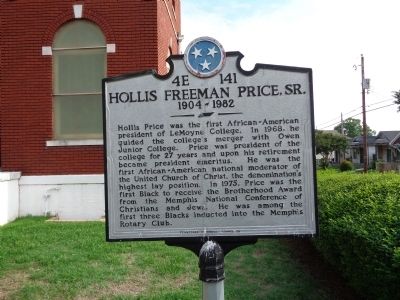
 
 
Hollis Freeman Price, Sr. Marker image. Click for full size.
Photographed By Steve Masler, May 28, 2015
1. Hollis Freeman Price, Sr. Marker

Inscription.   Hollis Price was the first African-American president of LeMoyne College. In 1968, he guided the college's merger with Owen Junior College. Price was the president of the college for 27 years and upon his retirement became president emeritus. He was the first African-American national moderator of the United Church of Christ, the denomination's highest lay position. In 1975, Price was the first Black to receive the Brotherhood Award from the Memphis National Conference of Christians and Jews. He was among the first three Blacks inducted into the Memphis Rotary Club.
 
Erected by Tennessee Historical Commission. (Marker Number 4E 141.)
 

Monday, September 9, 2024

A00056 - Gwendolyn Bennett, Harlem Renaissance Poet and Illustrator


Overlooked No More: Gwendolyn B. Bennett, Harlem Renaissance Star Plagued by Misfortune

She was a talented young poet and artist who was central to a fledgling cultural movement, but her life was shrouded by one tragedy after another.

Listen to this article · 9:26 min Learn more
A black and white portrait of Gwendolyn Bennett, her hair pulled back while she smiles and looks away from the camera.
Gwendolyn Bennett was one of the earliest Black artists of the Harlem Renaissance movement to put race at the forefront of her work.Credit...Schomburg Center for Research in Black Culture, Photographs and Prints Division, The New York Public Library

This article is part of Overlooked, a series of obituaries about remarkable people whose deaths, beginning in 1851, went unreported in The Times.

On March 21, 1924, a group of artists, writers and intellectuals filled the distinguished Civic Club in Manhattan for a dinner party, one that would turn out to be a pivotal moment in the early days of the Harlem Renaissance.

The event was conceived to celebrate Jessie Fauset, the novelist, poet and literary editor of The Crisis, the official magazine of the N.A.A.C.P., who had just published a new novel, “There Is Confusion.” But it wasn’t Fauset who captivated the crowd with a reading. Nor was it W.E.B. Du Bois, the éminence grise at the event, who capped the evening with a reading.

Rather, it was one of the youngest talents at the party, Gwendolyn Bennett, a 21-year-old poet and artist who entranced the room with “To Usward,” a poem she dedicated to Fauset and “to all Negro youth known and unknown who have a song to sing, a story to tell or a vision for the sons of earth.” It went, in part:

For some of us have songs to sing
Of jungle heat and fires
And some of us are solemn grown
With pitiful desires,
And there are those who feel the pull
Of seas beneath the skies,
And some there be who want to croon
Of Negro lullabies.

Advertisement

SKIP ADVERTISEMENT

Bennett would go on to write some of the most elegant poetry of the era, illustrate dynamic covers for prominent Black journals and form close relationships with luminaries like Du Bois, Langston Hughes and Richard Wright. Yet, by about 1930, her literary career had been derailed by emotional turmoil arising from a series of hardships, including her father’s death, an ill-fated marriage and unwarranted attention from the House Un-American Activities Committee.

Gwendolyn Bennetta Bennett was born on July 8, 1902, in the small East Texas town of Giddings. Her parents divorced when she was about 4, and her father, Joshua, kidnapped her and remained on the run with her for several years before landing in Washington, D.C., where he began practicing law. (It would be more than 15 years until Gwendolyn would reconnect with her mother, Mayme, a teacher.)

Bennett studied arts and drama at Columbia University’s Teachers College but transferred to Pratt Institute in Brooklyn because of what she called a “racist atmosphere” on the Columbia campus; she graduated in 1924. She was named a faculty member of fine arts at Howard University in Washington, then left for Paris on a scholarship the following year.

By the time she was 23 it was clear that Bennett was a rising star of what Alain Locke, one of the high-minded organizers of the Civic Club dinner, called the New Negro movement.

Advertisement

SKIP ADVERTISEMENT

“I really think of her almost like a poster child of the youthfulness of the movement at that point,” Melissa Barton, a curator of drama and prose for the Yale Collection of American Literature, said in an interview.

Bennett put race at the forefront of her work, both literary and artistic — one of the early Black creatives to do so. Her published poems (24 in all, from 1923 to 1934) were peppered with references to Black bodies, history and lives, and the verse could be lyrical, melancholy and even affronted in tone:

“I sailed in my dreams to the Land of Night/Where you were the dusk-eyed queen” (“Fantasy,” 1927); “I love you for your brownness,/And the rounded darkness of your breast” (“To a Dark Girl,” 1927); “Memory will lay its hand/Upon your breast/And you will understand/My hatred” (“Hatred,” 1926).

Historians regard her as a foundational member of the race-conscious writers of the Harlem Renaissance, that uptown blossoming of artistic and intellectual life.

“This is her acknowledging what she’s seeing in the world, but placing herself in the center of this space, in this new age for young African American artists,” Belinda Wheeler, co-editor of “Heroine of the Harlem Renaissance and Beyond: Gwendolyn Bennett’s Selected Writings” (2018, with Louis J. Parascandola), said in an interview.

Image
A black and white cover of Opportunity magazine, with the title of the magazine on top above the words "Journal of Negro Life," and a drawing of a swaying figure of a Black woman in the foreground and silhouetted figures of other people dancing behind her.
One of Bennett’s magazine covers, which may have been inspired by a performance by Josephine Baker that she saw in Paris.Credit...Schomburg Center for Research in Black Culture, Photographs and Prints Division, The New York Public Library

Bennett was also a stylish illustrator, exploring racial awareness through her covers for The Crisis and Opportunity, a literary journal essential to the Black community. Three in particular stand out, each with a different theme: mythological, religious and contemporary.

Advertisement

SKIP ADVERTISEMENT

Her cover for the March 1924 issue of The Crisis depicts a dark-skinned version of the Greek god Pan sleeping at the base of a tree while flanked by flute-playing satyrs, as dancers in the background engage in a Bacchanalian reverie. For the January 1926 cover of Opportunity, she drew the Virgin Mary and baby Jesus accepting gifts from the Three Kings, including one of African origin, wearing an Afro and hoop earrings.

And in July of that year, she depicted a swaying figure of a Black woman, draped in a fashionable dress while silhouetted figures behind her dance in what appears to be a stage show (one, clad only in a banana skirt, may be the singer and dancer Josephine Baker, whom Bennett had seen perform in Paris).

“She was a vibrant person,” said Sandra Govan, professor emeritus at University of North Carolina-Charlotte, who interviewed Bennett toward the end of her life. (She died in 1981.) “And she wanted to be engaged by everything.”

Paris in particular was a formative, albeit mixed, experience. Her letters to friends at home — Hughes, Locke, the young poet Countee Cullen, the patron Harold Jackman and the author Richard Wright, among others — were bursting with excitement but also reveal a yearning for what she was missing in Harlem.

Advertisement

SKIP ADVERTISEMENT

“She genuinely has FOMO,” Barton said. “The Harlem Renaissance is in full swing, and she’s just by herself.”

Image
A black and white photo of Bennett smiling and posing with a group of friends on a stoop.
Bennett with friends in the 1920s. She formed close relationships with leaders of the Harlem Renaissance.Credit...Schomburg Center for Research in Black Culture, Photographs and Prints Division, The New York Public Library

Indeed, Bennett was ahead of her time — more than two decades before figures like Wright and James Baldwin would make the Black artist-Paris connection famous.

Her first diary entry from Paris, on June 26, 1925, begins, “Could I mark this day I should put a black ring around it as one of the saddest days I have ever spent.”

Yet while she was there she met Gertrude Stein and Ernest Hemingway (whom she initially referred to as “Alan” in a letter). And the celebrated singer and actor Paul Robeson and his wife, Essie, took her to dine at the home of Henri Matisse (though it’s unclear if she actually met the artist there). “It was like going to a holy shrine,” she wrote to Jackman.

Advertisement

SKIP ADVERTISEMENT

And then there was Baker’s performance and the Paris nightlife scene in general. “Every vaudeville house, every cabaret, every dinner club and every tea dansante twirls to wild joy of the Negro’s dance,” Bennett wrote in an essay.

She returned to the United States in 1926 hoping to rejoin the Harlem art scene. She wrote a column, “Ebony Flute,” for Opportunity for two years and sat on the editorial board of the seminal one-off magazine Fire!!, alongside Hughes, Zora Neale Hurston and others.

Things then took a tragic turn. Her father is believed to have died by suicide that August. She returned to Howard University, only to resign the next year after controversy swelled when she got engaged to a student, Alfred Jackson.

In 1928, she married Jackson, by then a doctor, and they moved to Eustis, Fla., northwest of Orlando. By all accounts the marriage was an unhappy one. Her father’s death and her failed marriage “had a tremendous impact on her life,” Govan said in an interview. “She had to pull herself back up.”

In 1934, Bennett published poetry for the last time — a piece in Opportunity, appropriately called “Epitaph” — though she would continue to write for years to come.

Advertisement

SKIP ADVERTISEMENT
Image
A black and white photo booth strip of Bennett wearing a hat and smiling while looking in different directions across four frames.
Bennett in the 1930s. She turned to arts administration around this time, fostering young talent through the Harlem Artists Guild.Credit...Schomburg Center for Research in Black Culture, Photographs and Prints Division, The New York Public Library

Jackson died in 1936, and Bennett turned to arts administration, taking over direction of the Harlem Artists Guild. For the first time in years, she found a measure of happiness — and recognition. In 1939, she was one of 12 Black women honored by the Women’s Service League of Brooklyn as “distinguished women of today” at the New York World’s Fair.

But just before then, in 1938, the House Un-American Activities Committee had accused her of being a Communist because of her work through the guild. Their file, which would grow to 115 pages over decades despite yielding nothing, would haunt her for years.

Bennett had a tumultuous three-year affair with the Harlem-born painter Norman Lewis in the mid-1930s. In 1940, she married Richard Crosscup, a white teacher and social activist. After a series of other arts positions and teaching jobs, she moved with him to eastern Pennsylvania, settling in Kutztown, where they opened an antique store. The marriage was much happier than her first.

“I think the Crosscup marriage rescued her,” Govan said.

Crosscup died in 1980, leaving Bennett devastated. She died of heart failure the next year, on May 30, in Reading, Pa. She was 78.

Advertisement

SKIP ADVERTISEMENT

Though she never gained the wide audience she desired, Bennett left a rich legacy through her writing and art, and her passion and fortitude helped the Harlem Renaissance grow, through her own work as well as her fostering of young talent.

“I have decided that I will continue telling the story of the Negro’s cultural contribution to American culture,” she wrote to Locke in 1941, “no matter what my enemies have tried to do to me.”